
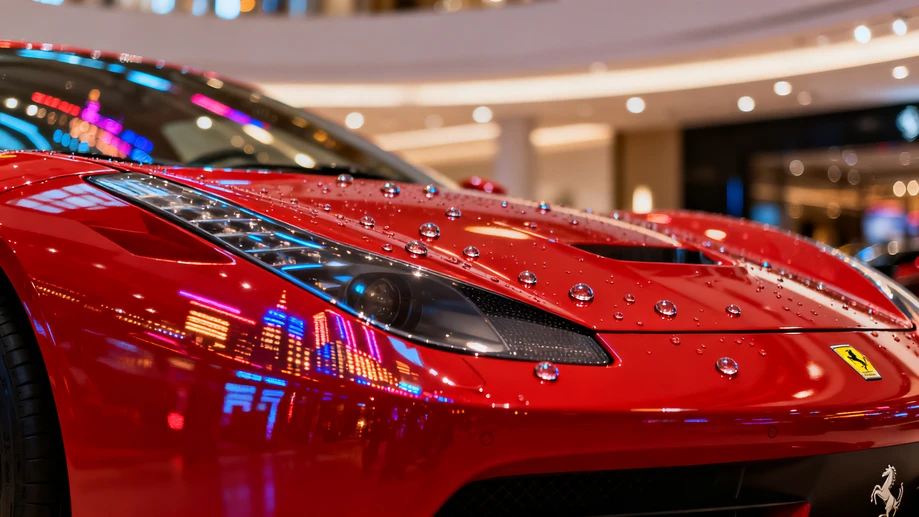
Ever Wondered Why Supercar Paint Costs More Than Your First Car?
The science behind those hypnotic finishes and head-turning silhouettes
Peer at any Bugatti or Rolls-Royce under sunlight and you’re witnessing centuries of chemical evolution. Modern luxury paints contain up to 20 micro-layers including ceramic nanoparticles that self-heal minor scratches when heated. Lamborghini’s signature "Verde Mantis" achieves its electric green by suspending crushed emerald particles in resin, while Rolls-Royce uses fish-scale essence for pearlescent effects. Forget mere color – we’re talking light-manipulating engineering where pigments refract sunlight like prisms, creating depth no smartphone camera can capture. This why a Bentley’s "Radium Silver" appears to glow from within while parked in shadow.
Shapes seduce long before paint glimmers. Designers employ "speed form" principles – curves mimicking cheetah muscles and lines that slice air with 0.01% less drag than regular cars. Aston Martin’s "hump line" rear fenders aren’t just sexy; they channel rainwater away from the cabin at 200mph. Ferrari creates optical illusions: the 296 GTB’s side vents angle inward to make the car appear crouched and ready to pounce even when stationary. Wind tunnel-tested scoops and diffusers double as visual punctuation marks, like Lamborghini’s hexagonal exhausts echoing the brand’s hexagonal DNA. Form doesn’t just follow function – it performs it with theatrical flair.
Color psychology governs luxury palettes. Black isn’t merely black: Porsche offers "Jet Black Metallic" for elegance and "Obsidian Black" for menace. Blue communicates different messages through midnight navy (sophistication) or McLaren’s "Azure Blue" liquid metal (innovation). Some shades are scientifically exclusive – Ferrari patented "Rosso Magma" by blending reflective glass flakes into red pigment. Bentley calculated that 70% of Phantom buyers choose two-tone schemes to visually "lighten" the massive body. And when Jay-Z rapped "I wake up, new Bugatti," he likely meant the $30,000 "Hermès Orange" – a custom shade taking 30 painters 450 hours to apply.
Maintenance becomes performance art. Owners avoid automatic car washes like plagues – spinning brushes inflict "swirl scars" requiring $20,000 repaints. Instead, they use pH-balanced water filtered through volcanic rock and lambswool mitts costing $300 each. Detailing products read like apothecary recipes: nano-ceramic sealants containing diamond dust, Swiss-made wax enriched with candelilla cactus. When a Pebble Beach concours judge spots an orange peel texture under raking light? That’s grounds for disqualification. Perfect paint demands monastic devotion – one collector stores his Pagani in nitrogen-filled bubble, while Ferrari Classiche certification requires original paint thickness measurements down to the micron.
Future innovations are already gleaming. BMW’s iX Flow uses E Ink panels to change color like a chameleon, while Mercedes "Hyper Screen" reduces physical vents for smoother surfaces. Sustainable metallics emerge too – Lamborghini’s "Arancio Borealis" uses pulverized orange peels instead of heavy metals. Yet classics endure: Rolls-Royce still hand-applies coachlines with squirrel-hair brushes requiring 3-year apprenticeships. Because in our digital age, nothing signals wealth like analog craftsmanship costing more per hour than brain surgery. Ultimately, supercar aesthetics deliver neurological witchcraft – triggering dopamine rushes before engines even start.